

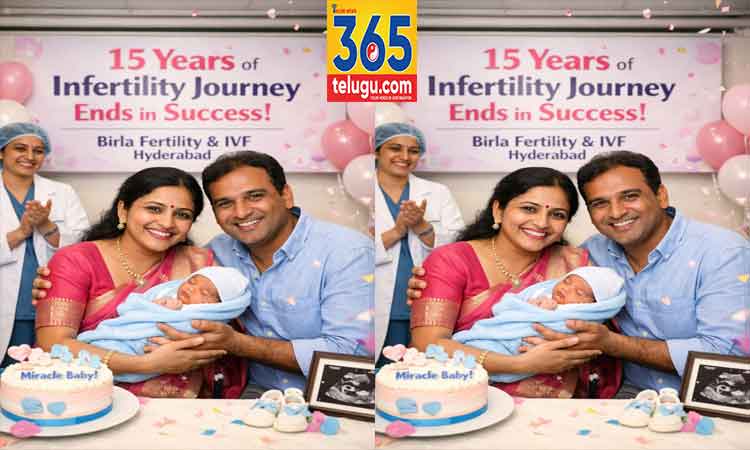
365telugu.com online news,HYDERABAD,January 31st,2026: After a decade and a half of medical hurdles, five failed IVF cycles, and multiple pregnancy losses, a couple has finally achieved a successful pregnancy at Birla Fertility & IVF in Hyderabad.
The case highlights the importance of precise diagnostics and the courage to pivot treatment strategies in complex infertility cases.
A History of Global Struggles
The couple, a 43-year-old woman and a 45-year-old man, sought help after exhausting options both in India and abroad. Their medical journey included:
Four failed IVF attempts in Australia with no viable embryos.
Read this also..Reliance Foundation Hits Major Skilling Milestone: 3 Lakh Youth Trained..
Read this also..Giants Set 168-Run Target in Playoff Decider..
One failed IVF attempt in India.
Three prior pregnancy losses, including two spontaneous abortions at the three-month mark.
While maternal age (43) was a known factor increasing genetic risks, previous treatments had largely overlooked a critical component: the male partner’s severe oligoasthenoteratozoospermia-a condition characterized by low sperm count, poor motility, and abnormal morphology.
Read this also..PhysicsWallah Launches Free Doubt Support & Mock Preboards for CBSE Class 10..
Read this also..Suzuki Matsuri Hyderabad Edition Draws Over 3,700 Biking Enthusiasts..
Upon arriving at the Hyderabad center, Dr. Alimileti Jhansi Rani, Consultant and Centre Head, opted for a deep-dive reassessment rather than repeating standard protocols.
“When a couple experiences repeated cycles without any embryo formation, it is vital to pause and identify the root cause,” explained Dr. Rani.
She noted that the combination of maternal age and the significant male factor made the chances of success using their own gametes extremely low.
Following detailed counseling on genetic risks and success probabilities, the couple made the difficult but strategic decision to proceed with embryo donation. To ensure the best possible environment for the pregnancy, the medical team performed:
Diagnostic Hysteroscopy: To optimize the uterine cavity.
Endometrial Preparation: A tailored cycle to ensure the lining was ready for implantation.
Single Embryo Transfer: Conducted under strict monitoring.
The subsequent pregnancy test returned a positive result, marking the end of a 15-year wait. Medical experts point to this case as a prime example of why fertility care must be adaptive.
In long-term infertility, success is often found not through sheer repetition of failed methods, but through recognizing biological limits and choosing a path backed by clinical evidence.